
Table of Contents
ToggleQuick Overview
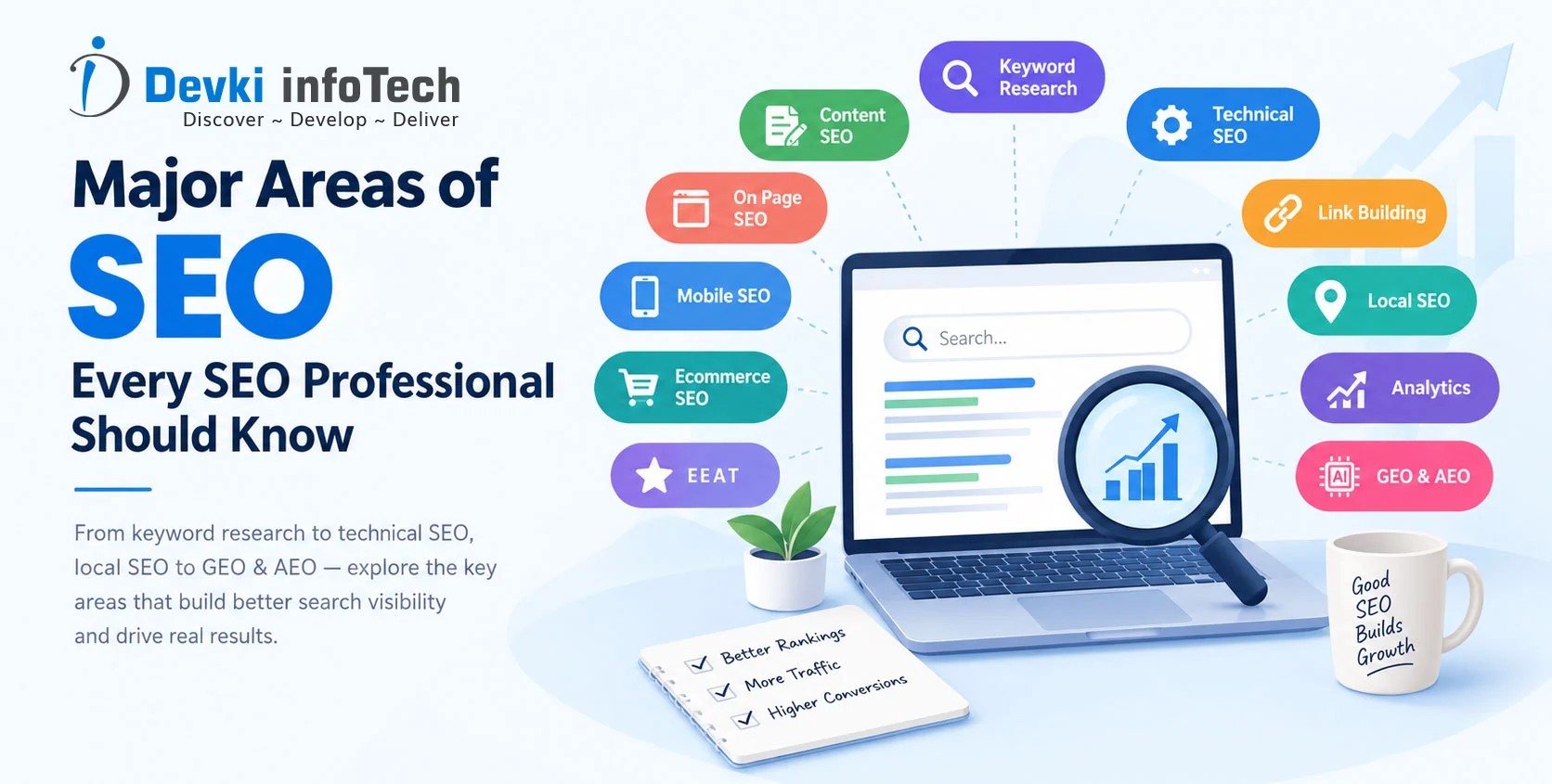
SEO is much more than adding keywords to a website. There are several major areas of SEO that professionals need to understand, from keyword research and content optimisation to technical SEO, local SEO, link building, analytics and the growing role of AI in search.
In this guide, we’ll explore these key areas and explain how each one can contribute to better search visibility, website performance and meaningful business results.
22 Major areas of Search Engine Optimization
- 1. Keyword Research & Search Intent
- 2. On Page SEO
- 3. Technical SEO
- 4. Content SEO
- 5. Local SEO
- 6. Off Page SEO
- 7. E E A T
- 8. Core Web Vitals & Page Experience
- 9. Mobile SEO
- 10. Image SEO
- 11. Internal Linking
- 12. Structured Data & Schema Markup
- 13. International & Multilingual SEO
- 14. Ecommerce SEO
- 15. Google Business Profile SEO
- 16. Analytics & Performance Tracking
- 17. Conversion Rate Optimisation
- 18. Competitor & SERP Analysis
- 19. Generative Engine Optimisation (GEO)
- 19. Generative Engine Optimisation (GEO)
- 20. Answer Engine Optimisation (AEO)
- 21. AI & Search Optimisation
- 22. SEO Audits & Reporting
1. Keyword Research & Search Intent
Keyword research is the starting point of SEO. It involves finding the words and phrases people use on search engines and understanding whether they are looking for information, a product, a service, or a specific business.
A good SEO professional does not focus only on search volume. They also consider relevance, competition, business value and search intent to choose keywords that can bring the right visitors.
Understand Your Audience: Know what your target audience is searching for and what problems they are trying to solve.
Find Seed Keywords: Start with broad keywords related to your business, services, products or niche.
Use Keyword Tools: Use Google Keyword Planner, Semrush, Ahrefs, Ubersuggest and other tools to discover keyword opportunities.
Analyse Search Intent: Understand whether the search is informational, navigational, commercial or transactional.
Check Keyword Metrics: Review search volume, keyword difficulty, CPC, competition and search trends.
Select & Organise Keywords: Choose relevant keywords and group them according to topics, pages, services or campaigns.
2. On Page SEO
On Page SEO focuses on improving the elements that are present on a website page. This includes the SEO title, meta description, headings, URL, content, keywords, images, internal links and overall page structure.
The goal is to make the page easy for both search engines and visitors to understand while naturally covering the topic and satisfying the user’s search intent.
Optimise SEO Titles: Create clear and relevant title tags that describe the page and encourage users to click.
Write Meta Descriptions: Provide a useful summary of the page that matches the search intent and supports better click through rates.
Structure Headings: Use H1, H2 and H3 headings to organise content logically and make the page easier to understand.
Optimise Content: Use relevant keywords naturally while providing useful, original and comprehensive information.
Optimise URLs: Keep URLs short, descriptive and relevant to the page topic.
Add Internal Links: Connect related pages to help users and search engines discover important content.
Optimise Images: Use descriptive file names, suitable formats, compressed images and meaningful alt text.
3. Technical SEO
Technical SEO deals with the technical health and structure of a website. It includes crawling, indexing, website speed, mobile usability, redirects, canonical URLs, XML sitemaps, robots.txt and fixing technical errors.
Even excellent content can struggle to perform if search engines cannot properly access, understand or index the website.
Improve Crawlability: Make sure search engine crawlers can access important pages without unnecessary restrictions.
Manage Indexing: Check which pages are indexed and prevent low value or unwanted pages from being indexed.
Create XML Sitemap: Maintain an accurate XML sitemap containing important indexable URLs.
Optimise Robots.txt: Use robots.txt correctly to guide crawlers without accidentally blocking important pages.
Fix Broken Links: Find and repair broken internal and external links that create poor user experiences.
Manage Redirects: Use appropriate redirects when pages or URLs are changed or removed.
Check Canonical URLs: Use canonical tags where necessary to help search engines understand the preferred version of a page.
Improve Site Speed: Reduce unnecessary scripts, optimise images and improve server performance to make pages load faster.
4. Content SEO
Content SEO is about creating useful and relevant content that genuinely answers what people are searching for. This can include service pages, blog posts, guides, FAQs, case studies and other helpful resources.
The focus should be on usefulness, accuracy, originality and relevance rather than simply inserting keywords repeatedly.
Understand Content Needs: Identify the questions, problems and information your target audience actually needs.
Create Helpful Content: Publish content that provides genuine value instead of writing only to target keywords.
Match Search Intent: Make sure each piece of content satisfies the reason behind the user’s search.
Use Topic Clusters: Build related content around important topics and connect supporting pages through internal links.
Add First Hand Experience: Include genuine examples, practical knowledge, case studies and insights where relevant.
Refresh Existing Content: Review older pages regularly and update outdated information, statistics, links and recommendations.
Maintain Content Quality: Check content for accuracy, originality, readability and usefulness before publishing.
5. Local SEO
Optimise Google Business Profile: Keep business name, category, address, phone number, services and other profile information accurate.
Target Local Keywords: Find keywords that include relevant cities, locations, neighbourhoods and local search phrases.
Create Location Pages: Develop useful location specific pages when the business genuinely serves those areas.
Build Local Citations: Maintain consistent business information across relevant directories and local platforms.
Manage Customer Reviews: Encourage genuine customer reviews and respond professionally to feedback.
Add Local Content: Create useful content related to local customers, services, areas and common questions.
Track Local Rankings: Monitor visibility in local search results and Google Maps for important keywords.
6. Off Page SEO
Off Page SEO focuses on signals that come from outside your own website. One of the main areas is earning relevant and trustworthy backlinks from other websites.
Good link building is about quality and relevance rather than collecting a large number of random links. Digital PR, industry mentions, partnerships and useful resources can also support off page visibility.
Find Link Opportunities: Identify relevant websites, publications, directories and industry platforms that may provide legitimate linking opportunities.
Earn Quality Backlinks: Create useful resources and content that other websites naturally want to reference.
Analyse Competitor Backlinks: Study where competitors are earning relevant links and identify suitable opportunities.
Build Digital PR: Promote useful stories, research, case studies and business achievements to relevant publications.
Monitor Backlink Profile: Regularly check new, lost and potentially harmful backlinks.
Focus on Relevance: Prioritise links from trustworthy and contextually relevant websites rather than simply chasing high numbers.
7. E E A T
E E A T stands for Experience, Expertise, Authoritativeness and Trustworthiness. It is a useful framework for creating content that demonstrates who is providing the information and why the information can be trusted.
SEO professionals should support these signals through accurate information, clear authorship where appropriate, credible references, genuine experience and transparent business information.
Show Real Experience: Demonstrate practical experience through original examples, case studies, projects and first hand insights.
Demonstrate Expertise: Provide accurate information supported by appropriate knowledge and expertise.
Build Authority: Strengthen the website’s reputation through credible mentions, references, publications and industry recognition.
Improve Trust: Clearly communicate business details, contact information, policies, credentials and other trust signals.
Add Author Information: Where appropriate, provide information about the people responsible for creating or reviewing content.
Support Important Claims: Use reliable sources and evidence when making factual, technical or data based claims.
8. Core Web Vitals & Page Experience
Core Web Vitals measure important aspects of a user’s experience when interacting with a webpage. They focus on areas such as loading performance, responsiveness and visual stability.
SEO professionals should work with developers to improve these areas because a fast, stable and responsive website creates a better experience for visitors.
Improve Loading Performance: Make important page content appear quickly for visitors.
Improve Responsiveness: Ensure the website responds smoothly when users click, tap or interact with page elements.
Prevent Layout Shifts: Keep images, advertisements and other elements from unexpectedly moving while the page loads.
Optimise Images: Compress images and use modern formats without unnecessarily reducing visual quality.
Reduce Unnecessary Code: Remove or minimise unused CSS, JavaScript and other resources where possible.
Improve Mobile Experience: Make sure pages are easy to use across different screen sizes and devices.
9. Mobile SEO
Mobile SEO ensures that a website works properly on smartphones and other smaller screens. Pages should be easy to read, buttons should be easy to use, navigation should be simple and important content should remain accessible.
Since many searches happen on mobile devices, SEO professionals need to consider the mobile experience throughout the optimisation process.
Use Responsive Design: Make the website automatically adapt to different screen sizes.
Improve Mobile Speed: Optimise images, scripts, fonts and other resources for faster mobile loading.
Make Navigation Simple: Ensure menus, buttons and important links are easy to find and use.
Improve Readability: Use suitable font sizes, spacing and layouts for smaller screens.
Avoid Intrusive Elements: Prevent pop ups and other elements from unnecessarily blocking important content.
Test Across Devices: Check important pages on different smartphones, browsers and screen sizes.
10. Image SEO
Images can support both user experience and search visibility when they are properly optimised. This includes using descriptive file names, appropriate image formats, compressed file sizes and useful alt text.
Image SEO also helps search engines understand what an image represents and makes content more accessible to users who rely on screen readers.
Use Descriptive File Names: Name images according to what they actually represent instead of using generic names.
Write Useful Alt Text: Describe the image accurately for accessibility and when the image cannot be displayed.
Compress Images: Reduce file size to improve page loading without unnecessarily affecting quality.
Choose the Right Format: Use suitable formats such as WebP or AVIF where supported and appropriate.
Add Image Context: Place images near relevant content so search engines can better understand their purpose.
Optimise Image Dimensions: Upload images at suitable dimensions instead of using unnecessarily large files.
11. Internal Linking
Internal linking means linking one page of your website to another relevant page on the same website. It helps visitors discover related information and makes it easier for search engines to understand the relationship between different pages.
A well-planned internal linking structure can also help distribute authority throughout important pages on the website.
Identify Related Pages: Find pages that naturally connect with each other based on topic and user intent.
Use Descriptive Anchor Text: Use meaningful link text that tells users and search engines what the destination page is about.
Link Important Pages: Give appropriate internal links to key service, product and landing pages.
Create Topic Connections: Connect supporting articles with related main pages to create a clear content structure.
Fix Orphan Pages: Identify important pages that have no internal links pointing to them.
Review Links Regularly: Check internal links for broken URLs, outdated pages and opportunities for better navigation.
12. Structured Data & Schema Markup
Structured data is a standardised way of providing additional information about a webpage to search engines. Depending on the content, this can include information about products, organisations, articles, events, businesses and other entities.
Correctly implemented structured data can help search engines understand the page and may make eligible content more clearly represented in search results.
Understand Schema Types: Learn which schema types are appropriate for articles, products, organisations, businesses and other content.
Add Relevant Markup: Implement structured data that accurately represents the information available on the page.
Avoid Misleading Data: Never add structured data for information that is not actually visible or supported by the page.
Test Schema: Use Google’s available testing and validation tools to identify implementation issues.
Keep Data Updated: Update structured data when important business, product or content information changes.
Monitor Search Appearance: Check whether eligible pages receive enhanced search features after implementation.
13. International & Multilingual SEO
International SEO is important for websites targeting users in different countries or regions. It involves handling country targeting, language versions, localised content and technical elements such as hreflang.
Simply translating the same page is not always enough. Content should also consider local terminology, search behaviour and user expectations.
Research Target Markets: Understand how people search for products and services in each target country or region.
Create Localised Content: Adapt content to local language, terminology, culture and user expectations instead of relying only on direct translation.
Use Hreflang Correctly: Help search engines understand which language or regional version should be shown to different users.
Optimise Country Targeting: Structure websites and URLs appropriately for different countries and markets.
Avoid Duplicate Translations: Make sure translated versions provide genuine value and are properly differentiated where necessary.
Track Each Market: Monitor organic visibility, traffic and conversions separately for different countries and languages.
14. Ecommerce SEO
Ecommerce SEO focuses on helping online stores gain organic visibility for product and category searches. It includes optimising product titles, descriptions, category pages, images, structured data and website architecture.
SEO professionals also need to manage issues such as duplicate product URLs, filters, pagination, out of stock products and large numbers of similar pages.
Optimise Product Pages: Create clear product titles, descriptions, images and useful information that matches buyer searches.
Optimise Category Pages: Build strong category pages that help users and search engines understand the products available.
Use Product Schema: Implement relevant structured data to provide search engines with accurate product information.
Manage Filters & Parameters: Prevent unnecessary URL variations from creating crawling, indexing and duplication problems.
Handle Out Of Stock Products: Use an appropriate strategy for temporarily or permanently unavailable products.
Optimise Product Images: Use high quality, properly sized images with descriptive file names and alt text.
Improve Product Navigation: Create a logical structure that allows users and search engines to move easily between categories and products.
15. Google Business Profile SEO
Google Business Profile plays an important role in local search visibility. SEO professionals should ensure that business information is accurate and complete and that relevant services, categories, photos and other details are maintained.
Reviews and genuine customer interactions can also contribute to a stronger local presence.
Complete Business Information: Add accurate business details including category, contact information, hours and services.
Choose Relevant Categories: Select the most appropriate primary and secondary categories for the business.
Add Services & Products: Keep the profile updated with relevant services or products where the feature is available.
Upload Quality Photos: Add genuine, relevant images that help customers understand the business.
Encourage Genuine Reviews: Ask real customers to share honest feedback about their experience.
Respond to Reviews: Reply professionally and appropriately to both positive and negative reviews.
Publish Relevant Updates: Use available profile posting features to share useful business updates and information.
16. Analytics & Performance Tracking
SEO should be measured rather than managed purely by assumptions. Tools such as Google Search Console and Google Analytics can provide useful information about organic traffic, search queries, clicks, impressions, user behaviour and conversions.
Regular tracking helps identify what is working, what needs improvement and which pages are generating meaningful business results.
Set Up Tracking: Properly configure analytics and search performance tools so important website activity can be measured.
Monitor Organic Traffic: Track how much traffic is coming from search engines and which pages receive it.
Analyse Search Queries: Review the searches that generate impressions and clicks for your website.
Track Conversions: Measure enquiries, calls, purchases, form submissions and other meaningful business actions.
Monitor Landing Pages: Identify which organic landing pages are attracting visitors and generating results.
Compare Performance: Compare SEO performance over time to identify growth, declines and seasonal changes.
Turn Data Into Actions: Use the data to decide what content, technical improvements or SEO activities should be prioritised next.
17. Conversion Rate Optimisation
Getting visitors from Google is only one part of SEO. Conversion Rate Optimisation focuses on what happens after someone reaches the website.
Clear calls to action, useful service information, easy navigation, enquiry forms, trust signals and strong landing pages can help turn organic visitors into enquiries, leads or customers.
Understand User Behaviour: Analyse how visitors interact with important landing and service pages.
Improve Calls To Action: Make enquiry, purchase, booking or contact options clear and easy to find.
Build Trust: Use reviews, testimonials, certifications, case studies and clear business information where appropriate.
Simplify Forms: Keep lead forms easy to complete and ask only for information that is genuinely needed.
Improve Landing Pages: Make sure the page clearly explains the service or product and matches the visitor’s search intent.
Test Improvements: Compare different page elements and use actual performance data to understand what works better.
18. Competitor & SERP Analysis
Competitor analysis involves studying websites that are already appearing for your target searches. SEO professionals look at their content, website structure, backlinks, keywords, page experience and search visibility.
SERP analysis is equally important because the search results themselves reveal what Google is showing for a particular query and what type of content users may be expecting.
Identify Search Competitors: Find the websites competing for the keywords that matter to your business.
Analyse Top Ranking Pages: Study their content structure, topics, page experience, internal links and other visible SEO elements.
Study SERP Features: Look for featured snippets, local results, images, videos, FAQs, shopping results and other search features.
Find Content Gaps: Identify useful topics or questions competitors have not covered adequately.
Analyse Backlinks: Study competitors’ relevant backlink sources to discover potential opportunities.
Monitor Changes: Keep track of changes in search results and competitor strategies over time.
19. Generative Engine Optimisation (GEO)
GEO focuses on making information clear and useful for AI powered search and generative answer experiences. Content should be well structured, factually supported and easy for systems to understand.
Rather than creating content specifically to manipulate AI systems, the practical approach is to build authoritative pages that provide clear answers, useful context and reliable information.
Create Clear Information: Structure content so important information can be easily understood and referenced.
Strengthen Original Insights: Provide genuine experience, examples, data and useful information that adds something beyond generic content.
Support Factual Claims: Use credible sources and references when making important factual claims.
Build Brand Authority: Maintain consistent, trustworthy information about the business across relevant online sources.
Answer Specific Questions: Cover common questions clearly instead of forcing users to search elsewhere for basic information.
Keep Content Updated: Review important content regularly as facts, products, services and industry information change.
20. Answer Engine Optimisation (AEO)
AEO focuses on answering specific questions clearly and directly. This can involve well organised FAQs, concise answers, descriptive headings, structured content and information that directly addresses user queries.
The aim is to make important information easy for search engines and answer focused systems to identify and understand.
Identify Common Questions: Research the questions users ask around your products, services and topics.
Give Direct Answers: Answer important questions clearly and naturally without unnecessary filler.
Use Question Based Headings: Organise relevant sections around the questions users are actually searching for.
Structure Information Clearly: Use headings, lists, tables and concise sections where they make information easier to understand.
Add Relevant FAQs: Include useful frequently asked questions that genuinely address customer concerns.
Optimise for Conversational Search: Consider how people naturally phrase questions when using voice search and AI powered search experiences.
21. AI & Search Optimisation
AI is changing how people discover information and how SEO professionals research, analyse and create content. AI tools can assist with keyword research, content analysis, competitor research and technical tasks.
However, SEO professionals still need to check facts, add genuine value and maintain human oversight rather than publishing automatically generated content without proper review.
Understand AI Search: Learn how AI powered search experiences are changing the way users discover and consume information.
Use AI for Research: Use AI tools to support brainstorming, research, content analysis and SEO workflows.
Verify AI Generated Information: Check facts, statistics, sources and claims before publishing AI assisted content.
Add Human Expertise: Improve AI assisted content with genuine experience, examples, opinions where appropriate and business specific knowledge.
Avoid Mass Produced Content: Do not create large amounts of low value content simply to target more keywords.
Keep SEO Human Focused: Use AI as a supporting tool while keeping the needs and experience of real users at the centre.
22. SEO Audits & Reporting
An SEO audit provides a detailed review of a website’s technical health, content, search visibility, links, user experience and other important areas.
Regular reporting then turns this information into measurable insights, such as changes in organic traffic, impressions, clicks, rankings, leads and conversions. The important part is not just reporting numbers, but explaining what changed, why it changed and what should be done next.
Perform Technical Audits: Check crawling, indexing, speed, redirects, broken links, sitemap, robots.txt and other technical areas.
Audit On Page SEO: Review titles, descriptions, headings, content, URLs, images and internal linking.
Review Backlinks: Analyse the website’s backlink profile and identify relevant opportunities or potential concerns.
Check Keyword Performance: Monitor rankings, impressions, clicks and visibility for important keywords.
Analyse Traffic & Conversions: Look beyond rankings and measure whether SEO is generating meaningful website traffic and business results.
Create Action Plans: Turn audit findings into clear tasks based on impact and priority.
Prepare Regular Reports: Show what changed, what was completed, what results were achieved and what should happen next.
Summary
SEO covers many different areas, and each one plays an important role in improving a website’s visibility, user experience and overall performance. From keyword research, on page SEO and technical SEO to content, local SEO, link building, analytics, E E A T, GEO and AEO, a successful SEO strategy requires a well balanced approach.
Understanding these major areas of SEO helps businesses identify opportunities, fix website issues, create useful content and attract more relevant visitors from search engines. SEO is an ongoing process, so regularly analysing performance and adapting to changes in search behaviour is essential for long term growth.
Grow Your Online Visibility with Devki Infotech
At Devki Infotech, we provide professional SEO services designed to help businesses improve their search visibility and attract relevant organic traffic. Our approach covers important areas of SEO, including keyword research, on page optimisation, technical SEO, content optimisation, local SEO, link building and performance tracking.
Whether you are a startup, small business or established organisation, we focus on creating practical SEO strategies based on your business goals, target audience and competition. With continuous monitoring and optimisation, we help businesses build a stronger online presence and create better opportunities through organic search.
Frequently Asked Questions About SEO
1. What are the major areas of SEO?
The major areas of SEO include keyword research, on page SEO, technical SEO, content SEO, local SEO, off page SEO, E E A T, analytics, ecommerce SEO, GEO, AEO and SEO reporting.
2. Why is it important to understand different areas of SEO?
SEO involves more than keyword optimisation. Understanding different areas helps SEO professionals improve technical performance, content quality, search visibility, user experience and overall website performance.
3. What is the most important area of SEO?
There is no single area that works independently. A strong SEO strategy usually combines technical SEO, useful content, keyword research, on page optimisation, authority building and performance analysis.
4. What is the difference between on page SEO and technical SEO?
On page SEO focuses mainly on page content and elements such as titles, headings, URLs and internal links. Technical SEO focuses on how effectively search engines can crawl, understand and index the website.
5. Is keyword research still important for SEO?
Yes. Keyword research helps businesses understand what their audience is searching for and the intent behind those searches. It helps guide content and page optimisation towards relevant topics.
6. What is the role of content in SEO?
Good content answers users’ questions, provides useful information and matches their search intent. High quality content can help a website demonstrate expertise while attracting relevant organic traffic.
7. What is local SEO and who needs it?
Local SEO helps businesses appear in searches related to specific locations. It is particularly useful for businesses serving customers in particular cities, areas or regions.
8. How do backlinks help SEO?
Relevant and trustworthy backlinks can contribute to a website’s authority and visibility. The focus should be on earning quality links from credible and contextually relevant websites rather than simply building a large number of links.
9. What are GEO and AEO in SEO?
GEO, or Generative Engine Optimisation, focuses on making content useful and understandable for AI powered search experiences. AEO, or Answer Engine Optimisation, focuses on providing clear answers to specific questions users search for.
10. How do I measure whether my SEO strategy is working?
SEO performance can be measured using metrics such as organic traffic, impressions, clicks, keyword visibility, engagement, leads, enquiries and conversions. Tools such as Google Search Console and Google Analytics can help track these results.